Sunday, January 10

Ensuring The Longetivity Of Digital Documents

[The following article appeared in Scientific American in 1995 (full bibliography appears near the end). It presents an intriguing premise we should all be mindful of, even 15 years hence. Food for thought.]

Ensuring the Longevity of Digital Documents

The digital medium is replacing paper in a dramatic record-keeping revolution. But such documents may be lost unless we act now

by Jeff Rothenberg
The year is 2045, and my grandchildren (as yet unborn) are exploring the attic of my house (as yet unbought). They find a letter dated 1995 and a CD-ROM. The letter says the disk contains a document that provides the key to obtaining my fortune (as yet unearned). My grandchildren are understandably excited, but they have never before seen a CD--except in old movies. Even if they can find a suitable disk drive, how will they run the software necessary to interpret what is on the disk? How can they read my obsolete digital document?

This imaginary scenario reveals some fundamental problems with digital documents. Without the explanatory letter, my grandchildren would have no reason to think the disk in my attic was worth deciphering. The letter possesses the enviable quality of being readable with no machinery, tools or special knowledge beyond that of English. Because digital information can be copied and recopied perfectly, it is often extolled for its supposed longevity. The truth, however, is that because of changing hardware and software, only the letter will be immediately intelligible 50 years from now.

Information technology is revolutionizing our concept of record keeping in an upheaval as great as the introduction of printing, if not of writing itself. The current generation of digital records has unique historical significance. Yet these documents are far more fragile than paper, placing the chronicle of our entire period in jeopardy.

My concern is not unjustified. There have already been several potential disasters. A 1990 House of Representatives report describes the narrow escape of the 1960 U.S. Census data. The tabulations were originally stored on tapes that became obsolete faster than expected as revised recording formats supplanted existing ones (although most of the information was successfully transferred to newer media). The report notes other close calls as well, involving tapes of the Department of Health and Human Services; files from the National Commission on Marijuana and Drug Abuse, the Public Land Law Review Commission and other agencies; the Combat Area Casualty file containing P.O.W. and M.I.A. records for the Vietnam War; and herbicide information needed to analyze the impact of Agent Orange. Scientific data are in similar jeopardy, as irreplaceable records of numerous experiments conducted by the National Aeronautics and Space Administration and other organizations age into oblivion.

So far the undisputed losses are few. But the significance of many digital documents--those we consider too unimportant to archive--may become apparent only long after they become unreadable. Unfortunately, many of the traditional methods developed for archiving printed matter are not applicable to electronic files. The content and historical value of thousands of records, databases and personal documents may be irretrievably lost to future generations if we do not take steps to preserve them now.

From Here to Eternity

Although digital information is theoretically invulnerable to the ravages of time, the physical media on which it is stored are far from eternal. If the optical CD in my attic were a magnetic disk, attempting to read it would probably be futile. Stray magnetic fields, oxidation and material decay can easily erase such disks. The contents of most digital media evaporate long before words written on high-quality paper. They often become unusably obsolete even sooner, as media are superseded by new, incompatible formats--how many readers remember eight-inch floppy disks? It is only slightly facetious to say that digital information lasts forever--or five years, whichever comes first.

Yet neither the physical fragility of digital media nor their lemminglike tendency toward obsolescence constitutes the worst of my grandchildren's problems. My progeny must not only extract the content of the disk but must also interpret it correctly. To understand their predicament, we need to examine the nature of digital storage. Digital information can be saved on any medium that is able to represent the binary digits ("bits") 0 and 1. We will call an intended, meaningful sequence of bits, with no intervening spaces, punctuation or formatting, a bit stream.

Retrieving a bit stream requires a hardware device, such as a disk drive, and special circuitry for reading the physical representation of the bits from the medium. Accessing the device from a given computer also requires a "driver" program. After the bit stream is retrieved, it must still be interpreted. This task is not straightforward, because a given bit stream can represent almost anything--from a sequence of integers to an array of dots in a pointillist-style image.

Furthermore, interpreting a bit stream depends on understanding its implicit structure, which cannot explicitly be represented in the stream. A bit stream that represents a sequence of alphabetic characters may consist of fixed-length chunks ("bytes"), each representing a code for a single character. For instance, in one current scheme, the eight bits 01110001 stand for the letter q. To extract the bytes from the bit stream, thereby "parsing" the stream into its components, we must know the length of a byte.

One way to convey the length is to encode a "key" at the beginning of the bit stream. But this key must itself be represented by a byte of some length. A reader therefore needs another key to understand the first one. Computer scientists call the solution to such a recursive problem a "bootstrap" (from the fanciful image of pulling oneself up by the bootstraps). In this case, a bootstrap must provide some context, which humans can read, that explains how to interpret the digital storage medium. For my grandchildren, the letter accompanying the disk serves this role.

After a bit stream is correctly parsed, we face another recursive problem. A byte can represent a number or an alphabetic character according to a code. To interpret such bytes, therefore, we need to know their coding scheme. But if we try to identify this scheme by inserting a code identifier in the bit stream itself, we will need another code identifier to interpret the first one. Again, human-readable context must serve as a bootstrap.

Even more problematic, bit streams may also contain complex cross-referencing information. The stream is often stored as a collection, or file, of bits that contains logically related but physically separate elements. These elements are linked to one another by internal references, which consist of pointers to other elements or of patterns to be matched. (Printed documents exhibit similar schemes, in which page numbers serve as pointers.)

Interpreting a Bit Stream

Suppose my grandchildren manage to read the bit stream from the CD-ROM. Only then will they face their real challenge: interpreting the information embedded in the bit stream. Most files contain information that is meaningful solely to the software that created them. Word-processing files embed format instructions describing typography, layout and structure (titles, chapters and so on). Spreadsheet files embed formulas relating their cells. So-called hypermedia files contain information identifying and linking text, graphics, sound and temporal data.

For convenience, we call such embedded information--and all other aspects of a bit stream's representation, including byte length, character code and structure--the encoding of a document file. These files are essentially programs: instructions and data that can be interpreted only by appropriate software. A file is not a document in its own right--it merely describes a document that comes into existence when the file is interpreted by the program that produced it. Without this program (or equivalent software), the document is a cryptic hostage of its own encoding.

Trial-and-error might decode the intended text if the document is a simple sequence of characters. But if it is complex, such a brute-force approach is unlikely to succeed. The meaning of a file is not inherent in the bits themselves, any more than the meaning of this sentence is inherent in its words. To understand any document, we must know what its content signifies in the language of its intended reader. Unfortunately, the intended reader of a document file is a program. Documents such as multimedia presentations are impossible to read without appropriate software: unlike printed words, they cannot just be "held up to the light."

Is it necessary to run the specific program that created a document? In some cases, similar software may at least partially be able to interpret the file. Still, it is naive to think that the encoding of any document--however natural it seems to us--will remain readable by future software for very long. Information technology continually creates new schemes, which often abandon their predecessors instead of subsuming them.

A good example of this phenomenon occurs in word processing. Most such programs allow writers to save their work as simple text, using the current seven-bit American Standard Code for Information Interchange (or ASCII). Such text would be relatively easy to decode in the future if seven-bit ASCII remains the text standard of choice. Yet ASCII is by no means the only popular text standard, and there are proposals to extend it to a 16-bit code (to encompass non-English alphabets). Future readers may therefore not be able to guess the correct text standard. To complicate matters, authors rarely save their work as pure text. As Avra Michelson, then at the National Archives, and I pointed out in 1992, authors often format digital documents quite early in the writing process and add figures and footnotes to provide more readable and complete drafts.

If "reading" a document means simply extracting its content--without its original form--then we may not need to run the original software. But content can be lost in subtle ways. Translating word-processing formats, for instance, often displaces or eliminates headings, captions or footnotes. Is this merely a loss of structure, or does it impinge on content? If we transform a spreadsheet into a table, deleting the formulas that relate the table's entries to one another, have we affected content? Suppose the CD in my attic contains a treasure map depicted by the visual patterns of word and line spacings in my original digital version of this article. Because these patterns are artifacts of the formatting algorithms of my software, they will be visible only when the digital version is viewed using my original program. If we need to view a complex document as its author viewed it, we have little choice but to run the software that generated it.

What chance will my grandchildren have of finding that software 50 years from now? If I include a copy of the program on the CD, they must still find the operating system software that allows the program to run on some computer. Storing a copy of the operating system on the CD may help, but the computer hardware required to run it will have long since become obsolete. What kind of digital Rosetta Stone can I leave to provide the key to understanding the contents of my disk?

Migrating Bits

To prevent digital documents from being lost, we must first preserve their bit streams. That means copying the bits onto new forms of media to ensure their accessibility. The approach is analogous to preserving text, which must be transcribed periodically. Both activities require ongoing effort: future access depends on an unbroken chain of such migrations frequent enough to prevent media from becoming physically unreadable or obsolete before they are copied. A single break in this chain renders digital information inaccessible, short of heroic effort. Given the current lack of permanence of media and the rate at which their forms evolve, migration may need to be as frequent as once every few years. Conservative estimates suggest that data on digital magnetic tape should be copied once a year to guarantee that none of the information is lost. (Analog tapes may remain playable for many years because they record more robust signals that degrade more gradually.)

In the long run, we might be able to develop long-lived storage media, which would make migration less urgent. At the moment, media with increased longevity are not on the horizon. Nevertheless, the cost of migration may eventually force the development of such products, overriding our appetite for improved performance.

An ancient text can be preserved either by translating it into a modern language or by copying it in its original dialect. Translation is attractive because it avoids the need to retain knowledge of the text's original language, yet few scholars would praise their predecessors for taking this approach. Not only does translation lose information, it also makes it impossible to determine what information has been lost, because the original is discarded. (In extreme cases, translation can completely undermine content: imagine blindly translating both languages in a bilingual dictionary into a third language.) Conversely, copying text in its original language (saving the bit stream) guarantees that nothing will be lost. Of course, this approach assumes that knowledge of the original language is retained.

Archivists have identified two analogous strategies for preserving digital documents. The first is to translate them into standard forms that are independent of any computer system. The second approach is to extend the longevity of computer systems and their original software to keep documents readable. Unfortunately, both strategies have serious shortcomings.

On the surface, it appears preferable to translate digital documents into standard forms that would remain readable in the future, obviating the need to run obsolete software. Proponents of this approach offer the relational database (introduced in the 1970s by E. F. Codd, now at Codd & Date, Inc., in San Jose, Calif. ) as a paradigmatic example. Such a database consists of tables representing relations among entities. A database of employees might contain a table having columns for employee names and their departments. A second table in the database might have department names in its first column, department sizes in its second column and the name of the department head in a third. The relational model defines a set of formal operations that make it possible to combine the relations in these tables--for example, to find the name of an employee's department head.

Because all relational database systems implement this same underlying model, any such database can in principle be translated into a standard tabular form acceptable to any other system. Files represented this way could be copied to new media as necessary, and the standard would ensure readability forever.

Flaws of Translation

Regrettably, this approach is flawed in two fundamental ways. First, relational databases are less standardized than they appear. Commercial relational database systems distinguish themselves from one another by offering features that extend the relational model in nonstandard ways. Moreover, the limitations of such databases are already leading to the adoption of new models. The tables in a relational database cannot transparently show structure. That is, the database could not immediately make it clear that a corporation consisted of one headquarters, five national offices, 25 divisions and 100 departments. Various object-oriented database models (which can represent structure directly) are evolving to satisfy this need. Such rapid evolution is neither accidental nor undesirable. It is the hallmark of information technology.

Furthermore, far from being a representative example, relational databases are practically unique. No other type of digital document has nearly so formal a basis for standardization. Word processors, graphics programs, spreadsheets and hypermedia programs each create far more varied documents. The incompatibility of word-processing files exemplifies this problem. It did not arise simply because companies were trying to distinguish their products in the marketplace. Rather it is a direct outgrowth of the technology's tendency to adapt itself to the emerging needs of users.

As yet, no common application is ready to be standardized. We do not have an accepted, formal understanding of the ways that humans manipulate information. It is therefore premature to attempt to enumerate the most important kinds of digital applications, let alone to circumscribe their capabilities through standards. Forcing users to accept the limitations imposed by such standards or restricting all digital documents to contain nothing but text as a lowest common denominator would be futile. The information revolution derives its momentum precisely from the attraction of new capabilities. Defining long-term standards for digital documents may become feasible when information science rests on a more formal foundation, but such standards do not yet offer a solution.

Translating a document into successive short-term standards offers false hope. Successive translation avoids the need for ultimate standards, but each translation introduces new losses. Would a modern version of Homer's "Iliad" have the same literary impact if it had been translated through a series of intermediate languages rather than from the earliest surviving texts in ancient Greek? In theory, translating a document through a sequence of standards should enable scholars to reconstruct the original document. Yet that requires each translation to be reversible without loss, which is rarely the case.

Finally, translation suffers from a fatal flaw. Unlike English and ancient Greek, whose expressive power and semantics are roughly equivalent, digital documents are evolving so rapidly that shifts in the forms of documents must inevitably arise. New forms do not necessarily subsume their predecessors or provide compatibility with previous formats. Old documents cannot always be translated into unprecedented forms in meaningful ways, and translating a current file back into a previous form is frequently impossible. For example, many older, hierarchical databases were completely redesigned to fit the relational model, just as relational databases are now being restructured to fit emerging object-oriented models. Shifts of this kind make it difficult or meaningless to translate old documents into new standard forms.

The alternative to translating a digital document is to view it by using the program that produced it. In theory, we might not actually have to run this software. If we could describe its behavior in a way that does not depend on any particular computer system, future generations could re-create the behavior of the software and thereby read the document. But information science cannot yet describe the behavior of software in sufficient depth for this approach to work, nor is it likely to be able to do so in the near future. To replicate the behavior of a program, there is currently little choice but to run it.

For this reason, we must save the programs that generate our digital documents, as well as all the system software required to run those programs. Although this task is monumental, it is theoretically feasible. Authors often include an appropriate application program and operating system to help recipients read a digital document. Some applications and system software may remain ubiquitous, so that authors would need only to refer readers to those programs. Free, public-domain software is already widely available on the Internet. Moreover, when proprietary programs become obsolete, their copyright restrictions may expire, making them available to future users.

How can we provide the hardware to run antiquated systems and application software? A number of specialized museums and "retro-computing" clubs are attempting to maintain computers in working condition after they become obsolete. Despite a certain undeniable charm born of its technological bravado, this method is ultimately futile. The cost of repairing or replacing worn out components (and retaining the expertise to do so) must inevitably outweigh the demand for any outmoded computer.

Fortunately, software engineers can write programs called emulators, which mimic the behavior of hardware. Assuming that computers will become far more powerful than they are today, they should be able to emulate obsolete systems on demand. The main drawback of emulation is that it requires detailed specifications for the outdated hardware. To be readable for posterity, these specifications must be saved in a digital form independent of any particular software, to prevent having to emulate one system to read the specifications needed to emulate another.

Saving Bits of History

If digital documents and their programs are to be saved, their migration must not modify their bit streams, because programs and their files can be corrupted by the slightest change. If such changes are unavoidable, they must be reversible without loss. Moreover, one must record enough detail about each transformation to allow reconstruction of the original encoding of the bit stream. Although bit streams can be designed to be immune to any expected change, future migration may introduce unexpected alterations. For example, aggressive data compression may convert a bit stream into an approximation of itself, precluding a precise reconstruction of the original. Similarly, encryption makes it impossible to recover an original bit stream without the decryption key.

Ideally, bit streams should be sealed in virtual envelopes: the contents would be preserved verbatim, and contextual information associated with each envelope would describe those contents and their transformation history. This information must itself be stored digitally (to ensure its survival), but it must be encoded in a form that humans can read more simply than they can the bit stream itself, so that it can serve as a bootstrap. Therefore, we must adopt bootstrap standards for encoding contextual information; a simple, text-only standard should suffice. Whenever a bit stream is copied to new media, its associated context may be translated into an updated bootstrap standard. (Irreversible translation would be acceptable here, because only the semantic content of the original context need be retained.) These standards can also be used to encode the hardware specifications needed to construct emulators.

Where does this leave my grandchildren? If they are fortunate, their CD may still be readable by some existing disk drive, or they may be resourceful enough to construct one, using information in my letter. If I include all the relevant software on the disk, along with complete, easily decoded specifications for the required hardware, they should be able to generate an emulator to run the original software that will display my document. I wish them luck.

JEFF ROTHENBERG is a senior computer scientist in the social policy department of the RAND Corporation in Santa Monica, Calif. He received a master's degree in computer science from the University of Wisconsin in 1969 and then spent the next four years working toward a doctorate in artificial intelligence. His research has included work in modeling theory, investigations into the effects of information technology on humanities research, and numerous studies involving information technology policy issues. His passions include classical music, traveling, photography and sailing.

FURTHER READING

TEXT AND TECHNOLOGY: READING AND WRITING IN THE ELECTRONIC AGE. Jay David Bolter in "Library Resources and Technical Services," Vol. 31, No. 1, pages 12-23; January-March 1987.

TAKING A BYTE OUT OF HISTORY: THE ARCHIVAL PRESERVATION OF FEDERAL COMPUTER RECORDS. Report 101-978 of the U.S. House of Representatives Committee on Government Operations, November 6, 1990.

ARCHIVAL MANAGEMENT OF ELECTRONIC RECORDS. Edited by David Bearman. Archives and Museum Informatics, Pittsburgh, 1991.

UNDERSTANDING ELECTRONIC INCUNABULA: A FRAMEWORK FOR RESEARCH ON ELECTRONIC RECORDS. Margaret Hedstrom in American Archivist, Vol. 54, No. 3, pages 334-354; Summer 1991.

ARCHIVAL THEORY AND INFORMATION TECHNOLOGIES: THE IMPACT OF INFORMATION TECHNOLOGIES ON ARCHIVAL PRINCIPLES AND PRACTICES. Charles M. Dollar. Edited by Oddo Bucci. Information and Documentation Series No. 1, University of Macerata, Italy, 1992.

SCHOLARLY COMMUNICATION AND INFORMATION TECHNOLOGY: EXPLORING THE IMPACT OF CHANGES IN THE RESEARCH PROCESS ON ARCHIVES. Avra Michelson and Jeff Rothenberg in "American Archivist," Vol. 55, No. 2, pages 236-315; Spring 1992.

SCIENTIFIC AMERICAN January 1995 Volume 272 Number 1 Pages 42-47

Scientific American (ISSN 0036-8733), published monthly by Scientific American, Inc., 415 Madison Avenue, New York, N.Y. 10017-1111. Copyright 1994 by Scientific American, Inc. All rights reserved. Except for one-time personal use, no part of any issue may be reproduced by any mechanical, photographic or electronic process, or in the form of a phonographic recording, nor may it be stored in a retrieval system, transmitted or otherwise copied for public or private use without written permission of the publisher. For information regarding back issues, reprints or permissions, E-mail SCAinquiry@aol.com.


Saturday, January 9

Chris Buttars Is Going To Love This One

It's already a forgone conclusion that Chris Buttars is a homophobe. That much is certain, considering events in recent Utah Legislative sessions. But this year, it's gonna hit real close to home.

On the other side of the Capitol from where Mr. Buttars sits, will be Rep. Christine Johnson, D-Salt Lake City, who will have another active role than just being a member of the Legislature. The lesbian lawmaker announced she's a surrogate mother, carrying a baby for two gay men from Salt Lake City.

Senator Howard Stephenson, R-Draper, says "I do respect any woman who will carry and bear a child for a childless couple ... It's my responsibility to show respect and love for one of God's daughters."

House Speaker David Clark, R-Santa Clara, agrees. "At the end of the day, it's the gift of life" that is important, he said.

The article from the Associated Press closes by saying "...Johnson said she doesn't think her constituents will react negatively to her pregnancy." Then again, her constituents are from the most liberal city in Utah.

Constituents aside, how one Senator in particular reacts is anybody's guess.

Stay tuned.

When I'm Quiet

...things may be going on in my head Marilee would rather not know about.

Case in point: Just now we were watching a TiVo'ed recording of the Smoking Gun's World's Dumbest. I made some snide comment about the show's uniqueness, and she said something equally as snide that I had found it, and anything - negative or positive - was therefore my fault.

At which time I picked up the netbook and became rather quiet.

What the original thought ws, I cannot remember, but the event will be remembered for quite some time.

"Shall I blog about this next time dear?"

Thursday, January 7

Clutter

I try not to collect more clutter than I can deal with, but sometimes it gets a bit too deep. Similarly, my blog might, from time to time anyway, get cluttered as I try out new and varied ways to keep you around. After all, the idea is for me to write, and you to read. What a concept.

So tonight, I have added more "stuff" which I hope doesn't clutter the landscape too badly.

It's called LinkWithin; you'll see it as either five small thumbnails of content between my posts or as five separate text links. Not to worry, though - all the links remain within my blog, so you won't have to leave. Immediately, anyway.

Oh, and the best part about LinkWithin? It's free.

Give LinkWithin serious consideration for your blog - it can only increase your traffic, and there's nothing wrong with that!

Seen On Twitter

Johnny Carson once said there were several billion inhabitants of planet earth. That the population had grown to that extent during the entirety of his reign on the Tonight Show. And that the majority of those people would soon have their own late-night talk show.

With the current state of the economy and so many out of work, was this gem on Twitter:

14.9 million Americans are now unemployed. That's a lot of new blogs.

(via @badbanana)

Going Backward

Why is it that perfectly good phrases either go out of style or are replaced by seemingly overburdened phrases?

Case in point: "Going forward". What was so wrong with "in the future"?

Similarly, "at this point" has been further emphasized by adding "in time".

I'd really like to know who the a$$hole overpaid MBA was that originated "going forward". Oh, wait, this isn't just Bob's version of bs. I'm not the only one who believes we've heard enough of the phrase.

In Charles Cooper's blog over at CNET, he wonders the same thing. He suggests it become somewhat of a drinking game. Every time some suit says "going forward", donate a hundred bucks to some deserving charity.

That's a future we can all believe in. Going forward.

Tuesday, January 5

Super, But Not Really A Hero

You read it here first. OK, so you just read it here.

Yes, Tiger Woods is still in the news. At The Daily Planet.

Brought to you by my crack reporting of The Soup's crack reporting of Entertainment Tonight's crack reporting of Vanity Fair's crack reporting is this video of... well, you be the judge.

Tall buildings, etc.

Too funny:

Is It Testing, Or Analysis?

I've a doctor's appointment today that will likely be the most gruelling of all the tests to date for my "condition."

Yeah, OK, so I haven't - still - been very specific. Don't expect anything more. Let's just continue to call it a "condition."

The appointment is a follow-on to this post, where I refer to "pieces being left to pick up."

THIS appointment is about the glue.

Monday, January 4

Just A Quick Acer Aspire Review

You'll recall I wrote about getting a new netbook last week. Not so much a Christmas present, but an early birthday one.

I've been playing with using it for just four days, and I'll tell you what...

Wait, there's a better story about this.

Over the weekend, Marilee bought an e-book from Barnes and Noble online. To view it, she had to download a program as well.

She: "Can I do this?"

Me: "I think you can handle it."

Some time later...

"Can you look at this? The program won't run."

So I look, mentally record the error, then hit the B&N website. I, too, download and run the program, and sure enough, it works OK on "The Little Guy."

The difference? "The Little Guy" is running Windows XP, and Marilee's laptop, Windows 2000.

Since my old decrepit Windows 2000 laptop, still threadbare, does still run, I figured I'd load the B&N program on it, too. Same problem, won't run. Though B&N says it'll run on 2000, it has likely been updated ad nauseum such that it no longer runs on the rock-solid OS.

So what's a geek to do, since she wants to read the e-book?

Begrudgingly I hand her "The Little Guy." And wonder when again I'll see it.

And only a few minutes into reading, says she:

"Do these come in pink?"

Yeah, I like "The Little Guy."

I'm typing on it now. The keyboard spacing takes a bit of getting used to, and the screen at 10.1 inches is just right for what I intend to use it for: Writing.

Small enough that It cradles nicely in my lap, and the screen brightness and clarity is perfect for corresponding and the impending Great American Novel.

Should you get one? Depends on what you'll use it for. Don't expect any high-level graphic editing, or high-end anything for that matter.

I'll have more of an idea in a week or so as far as real usability is, once I try going a bit more mobile and seeing what folks' reactions are. Thus far it's only Marilee, and Taylor calls it a mini-laptop.

If only I had a mini-lap.

Top This And Top That

OK, folks, the originality is waning. Do a search for "top ten 2009" on Google and the number is staggering.

OK, not quite a million, but getting close at 868,000.

Besides, who really cares about the Top Ten 2009 Cryptozoology Deaths? Unless you're a cryptozoologist, I suppose.

And Top Ten 2009 Costumes for Halloween? OK, so that list was made in August. August? Before Halloween?

And this gem: Top Ten 2009 Trinidad and Tobago Soca Songs, with the subtext of "so far".

OK, so maybe I'm going a bit too far. But so are the writers who don't seem to be able to come up with any new material.

What's next? Writing about top ten lists?

Oh wait...

Sunday, January 3

Demotivational Posters

Oh, yes, you are most certainly going to waste time with this one.

I absolutely hate the motivational poster concept. Most people do. Hate them, that is. In fact they turn out to be rather de-motivational. Sometimes even a laughing-stock.

So one company came out with the concept OF de-motivational posters. Despair, Inc., has been creating these familiar posters for some time; one favorite is shown below:

...maybe for obvious reasons.

As you can imagine, it's fairly easy to create this type of image - a picture, a border, and some catchy text. But what if you're not particularly adept at making you own de-motivational posters?

Would it be cool enough for you to find a do-it-yourself de-motivator?

Yeah, I thought so.

Also from Despair, Inc., is their Parody Motivator Generator.

Knock yourself out!

Never A Year Like '09

This was too cute not to post - yet another montage about the year past, but this time with production values:

Trib Trim

An article in the Trib yesterday - yes, I'm commenting on the other Salt Lake daily - says that to cut costs, they're going to make the Sunday comics smaller. Overall, trimming the section from eight pages to just six.

But they're not cutting content, just forcing some of the demographic to use magnifying glasses (their term).

They say in the article that in the past they've polled their readership as to what comics they'd rather see - the younger demographic wants "Get Fuzzy", for example. But the older demographic? Being of that "older" group, my concern would be losing the likes of Dennis the Menace, a moniker I personally have been referred to over the years. Being follicly challenged, I no longer have a cowlick, but still.

But what surprised me about the Trib's reference to the older demographic and what comics they'd rather not see leave the comic section runs to the likes of:

Prince Valiant
Rex Morgan, MD
Judge Parker
and...
Brenda Starr

WTF?

How long ago was that survey done?

Saturday, January 2

Heard On Tekzilla

If you want me to fix your PC, I accept Pastaware.

In other words, FEED ME.

Thursday, December 31

Another Top 10 Viral Video Montage

This time from Time:


The rest of Time's Top 10's are here.

Wednesday, December 30

All The Good Names

It's a foregone conclusion that all the good website names are taken. Company names, too.

While perusing dealsucker.com this morning, I happened on a company name straight out of the seventies. Seems a watch company has chosen a not-too-stellar name for its enterprise:

NIXON

Whiskey Tango Foxtrot.

Imagine a blue-stater wearing a Nixon watch.

OK, so they're fashionable, clean lines, all that watch-talk. But NIXON?

Advertising department do any research?

Guess they never heard of the infamous watch produced by equally infamous Dirty Time:

Yes, the Tricky Dicky Ticky.

Tuesday, December 29

Yeah, Explain This To The Kids

Chris got one of these from Ramin for Christmas. Funny how the male end of the connector is fuzzed out:

On Letting One's Hair Down

I watch Tekzilla. For the geek factor. For the cool toys tools. That Veronica Belmont Patrick Norton is one of the hosts has nothing whatever to do with it.

So as I watch Tekzilla every evening for their daily edition or the Thursday extended version, typically, Marilee is there on her laptop or lounging on the recliner, not actively watching, but still.

And the one topic that comes up on a nearly daily basis is: "When the hell is she going to do something else with her hair?"

Nope, not gonna go there.

Exclusive!

Oh. Come. On.

A teaser for an upcoming story on Good Morning America is touting a couple who was lost for THREE days after their GPS led them astray. A whole 35 miles out of their way.

Jill, any comment?

"The only thing worse than no map is an old map. That's what was said on an old paper-based map some twenty years ago. I have no recollection of it, but that damn guy who keeps telling me to shut the f..."

...me again. Sorry about that. Jill apparently does have a soul after all.

Really, though. Relying solely on a GPS for navigation is a bad idea. At least have some idea where you're going before setting out.

No, I didn't stay around for the story on GMA.

Monday, December 28

Remember When AOL Was The Center Of The Universe?

OK, maybe just in their mind. Time was, people thought America Online was the internet, and were quite dismayed when I'd tell them it was not.

AOL has apparently begun a thought process that says "We are who we are, and our logo should reflect that."

Old and new:So is AOL trying to tell us that if you're crazy enough to still be one of their members you should be viewing Rorschach ink blots?

From Famous Redesigned Logos of 2009.

Sunday, December 27

DON'T!

Marilee just said that to me. IN CAPS.

I got her a camera for Christmas. And I'm not allowed to touch it. Or help in any way, shape, or form. And it's probably better that way, since she'll learn how to use it herself.

I know not anything about it, other than the specs for it. It's a Fuji Z30. Pink in color. Ten megapixel. 2.7-inch screen. And that's about all I know.

Yes, admittedly, I didn't even know about it. Some sort of Santa's elf magic. Saw it for the first time on Christmas.

She'd had it out of the box for a few minutes earlier this morning - saw her toying with the thing.

After a nap, I'd asked how her camera was doing. Said she "I can't even figure out how the battery goes in."

Reversing direction on the stairs to see what I could do, she held down caps lock.

Wisely reversed direction yet again did I.

The Decade In Seven Minutes

Everything you need to know about the first decade of the millennium:


From Newsweek.

Saturday, December 26

The Great American Novel

Now here's a novel idea. Writing a novel.

It comes as no surprise that I enjoy writing. What's even more useful than writing the actual novel is finding someone interested enough to actually read the thing once you're done.

I saw a book tonight at Barnes and Noble that basically said you have to "sell" your book to an editor in the first five pages. Sometimes even the first page.

Five pages?

Hell, I have no idea I can write that many in the first place, but I'm willing to try.

I left the bookstore with a couple copies of Writer's Digest; I'm getting closer to starting.

At least I know I have to write at least five pages.

More on my writing here.

Why Pets Need Microchips

Out of Asheville, South Carolina is a heart-warming story about Sonny the cat being reunited with his owner TWELVE years later.

Read all about it at Citizen-Times' website.

It'll bring you to tears.

Friday, December 25

Yule Love This

Since it is, after all, Christmas, and at least here in Utah it's cold enough to freeze even the most hearty of souls, wouldn't it be "cool" to warm up by a raging fire?

Here, for your warming pleasure, is a Yule log in a fireplace. What with the heat generated from most computers nowadays, the effect is mostly complete. Look at it this way: no soot or ashes to clean up!

Thursday, December 24

Elf Rage

I created this for a friend:


If you'll recall, it is a follow-on to this post from earlier this year.

Merry Christmas from the BS-ery!

Just A Lil Bit

Meet Lil Bit:


Named by Taylor, loved by all, he is a lilac-point Siamese, though we suspect he's more Ragdoll. Judging by the photo, we're more for the latter.

Wednesday, December 23

About Searching For Sh!t On Google

That video on YouTube made me remember I hadn't yet posted about the search engine to beat all search engines.

Using the "Surprised kitty video" as an example, click here to see how it works.

Too damn funny.

Surprised Kitty

Yeah, you can search for this yourself at YouTube, but all you need do is find it right here:


Too damn cute.

Yeah, I Felt It

Did you?

We had an earthquake this morning around here - a 2.8 on the Richter.

It woke me up, but since I'm originally from California, I'm tuned in, you might say.

Only heard a slight "crack-like" sound and a gentle vibration. Nothing major. Or minor, for that matter.

More information on the quake from the USGS can be found here.

Tuesday, December 22

Are HP Computers Racist?

You be the judge of this video on Youtube:

The Video You've Heard About

"I Don't Like You Mommy":


Not surprising this wasn't on that last list.

Fun stuff!

Monday, December 21

woot!

I never paid much attention to what "woot" meant. I just considered it to be one of those cool web-centric made-up words that, well, sounded cool. And upon doing my considerable research in the matter, I found that "woot" has several meanings.

One such is that it a synonym for the word "root", a term that refers to having all-encompassing power over a computer. You know, administrative rights. Those rights the IT guys at your company have. Yes, root, with a speech impediment.

Woot also has more specific meaning; in computer gsming. it is a contraction for "Wow! Loot!" and is spelled thusly: w00t.

I'd heard both definitions over the years, but was not familiar with just plain "woot!". But as it turns out, that extra exclamation point makes all the difference.

Marilee found out about woot! from Jenn; in turn Marilee told me about it. Only a few days ago. I was checking it myslef each morning, but was rather surprised when she asked Sunday morning if I had looked at woot! that day.

A quick trip over there, and I was amazed. It was the lowest price I had ever seen on a netbook. I'd become enamored with netbooks ever since they began to appear, and couldn't wait to get one. As it is, this notebook I'm typing on is on its last legs, and according to Marilee it makes too much noise.

"That's what fans sound like."

"Whatever. Do you want the netbook or not?"

woot! has just one great deal per day, and some deals run out before the day is done. But not Sunday - my netbook is on the way!

Head over to woot! to see what you may find.

Sunday, December 20

My Wife Is An Alien

How do I know this? She told me so.

[I see your brow, how furrowed it is. Trust me, this actually makes sense.]

Besides - how many men suspect their spouses are from another planet? Thought so.

Think of it this way, with the following two examples:

Chewbacca. Chewie can understand everyone else, but only speaks Wookie, thus no one understands Chewie.

R2-D2. R2 understands everyone else, yet only squeaks and beeps, so no one understands R2.

In the above examples, Marilee is Chewbacca and R2-D2. No one understands her, yet understands everyone else.

See? Marilee is from a galaxy far, far away.

After all, she does have eyes in the back of her head.

I Cannot Win

Like I needed to be reminded of that.

Here's the deal: On a regular basis, when Marilee and I are in the family room watching TV, there are either animals of the feline or canine variety upon her person. All. The. Time.

And, on a regular basis, she exclaims "What are you two doing on me?" Turning to me, she'll say, equally as often, "What do they always get on top of ME?!"

"You're Marilee. They LOVE you."

So I'd like to think they love me, too, they just love Marilee more at certain times.

Last night, we went to bed rather late, and once again, the cats were upon Marilee; previously in the evening, the dogs were out and about, only to gravitate towards Marilee.

They were no where near me during those times, but then again, I'm more animated during those times, up and down doing other things.

Marilee went upstairs before I did, and having completed all the important stuff crap I needed believed I needed wanted to do, sat on the couch and watched some TV.

And no sooner had I got myself settled, around came the cats.

And sat upon my person.

Marilee and I are up rather early this Sunday. She, reading the paper, myself surfing. I turn in her direction, and proclaim something I would have expected would be good news.

"OH, by the way, I'll have you know the cats decided to climb on me last night before I went to bed. So it's not only you."

Somehow, as soon as that last little bit left my consciousness, I knew I was in trouble.

"That's supposed to be MY thing, not yours."

"But I thought..."

Oh.

See? I can't win.

Saturday, December 19

Rather Cool Train Video

OK, so portions are rather cold.


Above is a 9½ minute, forward-facing HD video on a train going across Norway to Oslo, but at 9½ minutes, it's only a portion of the entire video available for download from NRK in Norway.

You might want to make sure you've got plenty of hard drive space before you begin - it's a 22-gigabyte file, pared down from the 165-gigabyte original.

Oh, and set aside some viewing time as well - the full video runs 7½ hours.

Bonus: The 9½ minute video shows where the scenes from Hoth in Star Wars Episode V: The Empire Strikes Back were filmed.

Friday, December 18

Unusual Commentary

Peculiar comment left on a blog post I made on July 18th. Of last year.

The post, titled "Dogs Can't Add", had to do with Bambi and Princess waiting single-file to be let back into the house. They hadn't yet figured out that I'm the automatic part in the equation of "putting two-and-two together".

So far, so good.

But this morning, awaiting my approval, was a comment "Anonymous" had left, to wit: "...please where can I buy a unicorn?"

Wut?

Yes, dear reader, there's a reason I have the option set to approve comments before they're posted. I let this one slide because it's so "out there".

Other comments I've received can only be classified as spam. Obvioulsy automated, a comment riddled with links to God-only-knows websites are quickly dismissed.

But the unicorn comment? Hey, if it produces a visitor looking for unicorns, then just maybe I'll turn it into a post of its own volition.

Thursday, December 17

YouTube Videos Gone Viral

Can't believe I missed the "Evian Babies" video this year. Wonder what else was going on when it was popular:


That, and others like it, are featured on YouTube as tops for 2009. Enjoy.

There's No Spell Check In Photoshop


Wesite Designers of the world, please be sure to check your spelling when creating web graphics with text. That the following example is an animated GIF vs. Flash is of no matter.

On the other hand, if the spelling mistake is intentional, then your ploy worked, at least in my case.

This is only one example of poorly-created web graphics; more is available via my labelled posts here.

Wednesday, December 16

The Max Weinberg Mormon Song

Saw this on blurbomat, so I really did have to share.

No, really.

Internet Users Live Longer

It says so in the Deseret News this morning.

Well, sorta.

The Statistical Abstract of the United States 2010, also known as the
"Uncle Sam Almanac", available in its 129th annual edition, states that Utah is second only to Alaska in the number of deaths per 1,000 residents (Utah 5.3 vs. Alaska's 5.1).

Further, Utah is second only to our neighbor to the extreme north in internet usage - 82% to Alaska's 84.3%.

So, using the same formulaic wizardry that professional survey takers use - read: "The ability to pull numbers out of your ass" - Internet users live longer.

But only if you live in Alaska.

Tips For The Sensitive Christian

As we approach the holiday season, it's a good idea to be mindful of others and their religious beliefs - not everyone celebrates Christmas, after all.

Uh-oh, Bob's going into uncharted territory again. Best watch out, or black name badges will be knocking on the door and a lump of coal will be in my stocking.

Anyway.

From The New Yorker, a video of Tips for the Sensitive Christian:

Tuesday, December 15

Sometime In The Near Future

...there will be a headline on an online forum that declares:

I AM TIGER WOODS' LOVE CHILD!!!

Wonder how long the cease and desist letter will take to arrive.

Tiger's Action Plan

This is choice, considering it's from someone who has been in the news lately for less-than-stellar shenanigans of the bedroom variety:

From the Tiger Woods official website, a free program is available "...for young people to identify their own personal goals and take specific steps toward achieving them".

I'd be a bit suspicious of a program offered by a celebrity whose family life is as rocky as Woods' appears to be. It's bad enough that kids learn poor habits and questionable behaviors from their peers, but from someone that kids should be looking up to?

Pass.

Put A Tiger In Your Tank

Such was the ad from years ago for Esso gasoline:

I don't know if Esso is still around. Perhaps in another guise. Even if they are, they might be inclined to bring back the campaign and "ride the wave", as some other ad agencies are doing.

One such email advertisement - spoken in somewhat of a cockney accent - suggests that I "tee up" my endeavors to increase my ad revenues.

"Tee up"?

Is golf in the news?

Wonder how sales of Kellogg's Frosted Flakes are doing.

Monday, December 14

Home Again, Home Again

Jiggity jig.

Somehow, that ending from "This little piggy" sounds mildly offensive. [See note below]

Marilee and I arrived home yesterday from our mini-vacation in Las Vegas. We left rather early - for us anyway - at about 6:30am, and got home at about 2:30pm. Not bad, but considering we had seen ominous snow total warnings along the route, we really expected to not get home until after dark.

And for those of you who were following my adventures in California, might you ask how it was "Marilee and I"? She drove down from Salt Lake to meet me in Las Vegas. And drove home in separate vehicles. Don't ask.

Anyway, there's more to tell about the waning moments of my California trip, but for now I'm home and thankfully so.

Note: OK, so it has been many a year since I even said "Jiggity Jig", but that one is from "To market, to market, to buy a fat pig". Interesting though, wouldn't you say, that both have to do with pigs in this day and age of the swine flu.

Friday, December 11

LARGE PRINT

Was on Amazon last night looking for a book to listen to on the way home, and happened on a relaxation CD. While I did not purchase it - it was on CD and would arrive at home long after I got there - my powers of observation got the better of me and wondered just how an audio CD is available as a large print edition.

Take a look.

Damn Hippies

Saw the following block of ads on KSL's website this morning:


Pretty typical, I'd say. Whiter teeth, blood pressure snake oil, job offers, and...

I don't know what, exactly, to make of the other one. Is this what the people who did refinance look like, or the hundreds of thousands who did not?

Damn hippies.

Thursday, December 10

Sing A Song Of Six Peace

Common sense dictates that I should not blog about this.

As I have just gone through four Guinness', a Green Russian, and a Kamikaze, common sense went out the window about a half-hour ago.

Suffice to say, I just spent a most pleasant evening with several of my classmates at a sports bar here in the sunny (OK, it was after dark) climes of Southern California. Each was treated to that which happens to Bob when he has had a few too many drinks.

MOTOR MOUTH.

Yes, 'tis true, dear readers, I CAN be quite talkative when alcohol has been consumed. Whether it being a positive influence or not hasn't been decided yet - it really depends on what THEY remember.

What I DO remember is that the bartendress - or should it be barmaid, I'm not quite sure - was wearing a garment which said, in a quite noticeable location, was:
That it might have been laundered quite a few times is not of much importance, but apparently, from what my partners in crime said, it once said:
This was the first time - in a great many years, if not decades - that I had spent time in a real bar with that devil-may-care attitude that no one can come get me, as I was "stewed to the gills" in inebriation. Thankfully I was a short WALK from the bar to the hotel. One need not wonder what the outcome would have been had I driven to said drinking establishment.

Let's not go there.

But what was the most sobering thought was that this would likely be the last time, save for our final class tomorrow, that I would ever see these fine people again.

Pence to you all.

Dance, Love, Tweet?

The classic phrase about being unperturbed by the little things goes thusly:

"Work like you don't need money, love like you've never been hurt, and dance like no one's watching."

Whether that's the original, I'm not quite sure, as there are other versions everywhere, like:

"Work like you don't need the money. Love like you've never been hurt. Dance like no-one's watching. Sing like no-one's listening. Live like there's no tomorrow. Fear like a stone."

But one that is actually NEW and improved and mirrors our life as it now stands, is attributed to one Adrian Clark, which goes like this:

"Dance like the photo's not tagged, love like you've never been unfriended, tweet like nobody's following."

Must remember this one!

Wednesday, December 9

Yes, I'm Quite Positive

On one of the machines we were working on yesterday, a UPS had failed - when, we're not quite sure, but suffice to say it had seen better days. Fortunately, it was only a defective battery, which is rather easy to fix.

This whole subject started sharp jabs and quick witticisms between myself and my classmates that I'm still in awe of even now. After extricating the UPS from the machine and then the battery from its enclosure, the banter started something like this:

"Are you sure it's a bad battery?"
"Yes, I'm positive."

As is necessary to ensure you're not replacing a battery that was recently installed, it's always a good idea to write the date on it.

"Did you date it?"
"Yes, we went out to a movie. She got a charge out of it. The mood was electric."

OK, you had to be there.

But after that quick-witted repartee, the sounds in the room acquiesced a bit when I let fly my last comment:

"I've been working in electronics for thirty years and I've heard all those jokes about electricity."

"YOU'VE BEEN DOING THIS FOR HOW LONG?"

Home Is Where You Hang Your Hat

I'd never heard this expression until tonight, but it really does make sense. Provided, of course, that you have a hat in the first place. I suppose then that if you have no hat then you cannot call the place in which you live your home.

Anyway.

Dinner this evening on per diem was TGI Friday's in Cerritos. Had me a Jack Daniels Flatiron Steak with fixin's. Quite unlike my sensory overload of a few nights ago, this was more my style. Then again, I knew what to expect, since I'd been to Fridays before in other parts.

Not that it has any particular importance, but I kept my Guinness hat on as well as my jacket. Yet had I wanted to, I could have placed each on what I think is the coolest invention I'd ever seen. Up until then, anyway.

There were folding sets of coat hooks on pretty much every vertical post in the place. Which of course, is interesting since it never rains in Southern California, nor does it get cold. Well, Utah cold anyway. So what point would there be in having so many coat hooks? It doesn't much matter - put enough coat hooks in a place and even I would wear a jacket just to use one.

Upon returning back here to my hotel, I commenced a search to find this new invention. What I found, however, surprised the hell out of me:

They're not new.

In fact, they've been around for at least a hundred years.

Here, for your viewing pleasure, is a picture of a Marine Four Way Coat Hook:From the 19th Century. So what if it's a reproduction. Coming in both brass and chrome plating, they're also available both with and without balls on the ends.

I sense a project in the offing.

TMA

On my radar this morning is an article from Roy Peter Clark at Poynter Online, where he, too, suggests that writers use far too many acronyms.

TMA, BTW, is short for Too Many Acronyms.

Radar, in that first sentence up there, though now in lower-case, was an acronym at one time too: "RAdio Detecting And Ranging". Even the lower-case scuba was once just an acronym: "Self Contained Underwater Breathing Apparatus."

Do we use too many acronyms? Likely so, since many of us who use them on a regular basis have to de-acronym them if we're speaking to someone who may be clueless as to their true meanings.

One of the best-ever examples is this: PCMCIA refers to the ubiquitous rectangular cards slipped into the side of laptops for added functionality, such as wireless connectivity, and for USB connectors where the laptop may not have enough built-in. The correct meaning of PCMCIA is "Personal Computer Memory Card International Association", referring to the organization responsible for ensuring the devices conform to specifications. What the acronym should stand for, however, is this: "People Cannot Memorize Computer Industry Acronyms."

RPC's entire article can be found here.

Tuesday, December 8

Bert and BOB

Years ago - really YEARS ago - my parents got me some personalized pencils from a catalog. Or something. Not quite sure.

Yes, they were personalized, and they should have said "ROBERT" on them. But noooooo...

They were to have been in the classic stamped fake-gold leaf style, but part of the text had gone missing. ON 100 PENCILS. For many years after that, I was known as "BERT".

That whole time in my life popped into my consciousness today as we discussed RS232 serial communications in class. I cut my baby teeth on serial communications thirty-some-odd years ago, so I was mostly bored with the material, even was able to share my knowledge to some extent as portions were truly new material to my classmates.

So one of the many things we covered was how to troubleshoot serial communications - a common way is with some form of loopback connector, but to really do some serious troubleshooting, you need a Break-Out-Box.

Acronyms are something I've already written about here. So I won't bother you with those details again. But when an acronym hits a bit closer to home, it partly takes me by surprise, but also tends to make me a bit uncomfortable, as it did today.

Because you see, dear reader, the acronym for a Break-Out-Box is BOB.

ALL DAY LONG I heard BOB this and BOB that, never knowing if it was serial comm they were talking about or asking a question of me. So I started tuning it out. But then I remembered something else about serial comm I truly hadn't thought about in years. Decades maybe.

There's a device used to test the actual data going through a cable, and whether there are any errors due to the speed of the data. Called a Bit-Error-Rate-Tester, it's used in synchronous communications, the sort of stuff we were talking about today.

So you see, not only were we talking about me, BOB, but also pencils.

The acronym for a Bit-Error-Rate-Tester is BERT.

Lightweights

As I type this, it is currently 16° in Salt Lake City.

Conversely, it is currently 42° in Los Angeles.

The guy down at the hotel desk just said to me "A bit chilly out there, hm?"

Yeah, riiiiight.

Saturday, December 5

The Effects Of Drugging A Spider

Long story about why and how I found the following video. Had to do with peppermint schnapps and spinning straw into gold.

Amore

Found in the Caturday thread this morning on Fark:

Too damn funny.

Friday, December 4

The Dining Experience

Being on this business trip affords me the luxury of getting to eat at places I cannot afford. Normally, anyway. Per diem during the week is limited to dinner at the rate of $25. Really, not that bad at all.

But where I eat is of no consequence - what matters to me is if I can sit down and just enjoy the food without any atmosphere. Or flamboyance. Or, as was the case this evening, the "Dining Experience" to be had at the Macaroni Grill in Cerritos.

Admittedly, this was the first time I'd ever been to a Macaroni Grill, in California or Utah. So as my waiter squirted some olive oil in a little bowl and ground some pepper on top of it (less than an hour later I can sense the pepper making demands my gastrointestinal tract will not tolerate), and drew his name on the tablecloth paper, upside down no less, I was ready to bolt and/or scream "Just give me my damn food."

Ahem.

Sounds a bit similar to my shopping habits - I do not shop, I go to stores to buy things. Just ask Marilee.

Yes, the food was superb, don't get me wrong - yes, I know, I'll have a corporate stalker from Macaroni Grill hitting my blog by tomorrow - but I'd rather they leave the ambiance at the door.

Somewhat Amusing Quiz

Name that car:

AND PASSED WITH AN EXCELLENT SCORE! A+
Quiz Created By Auto Insurance.org

Of course I got an A-plus - I took the test twice. You don't think I'm gonna post my original score of a C-minus, do you?

Thursday, December 3

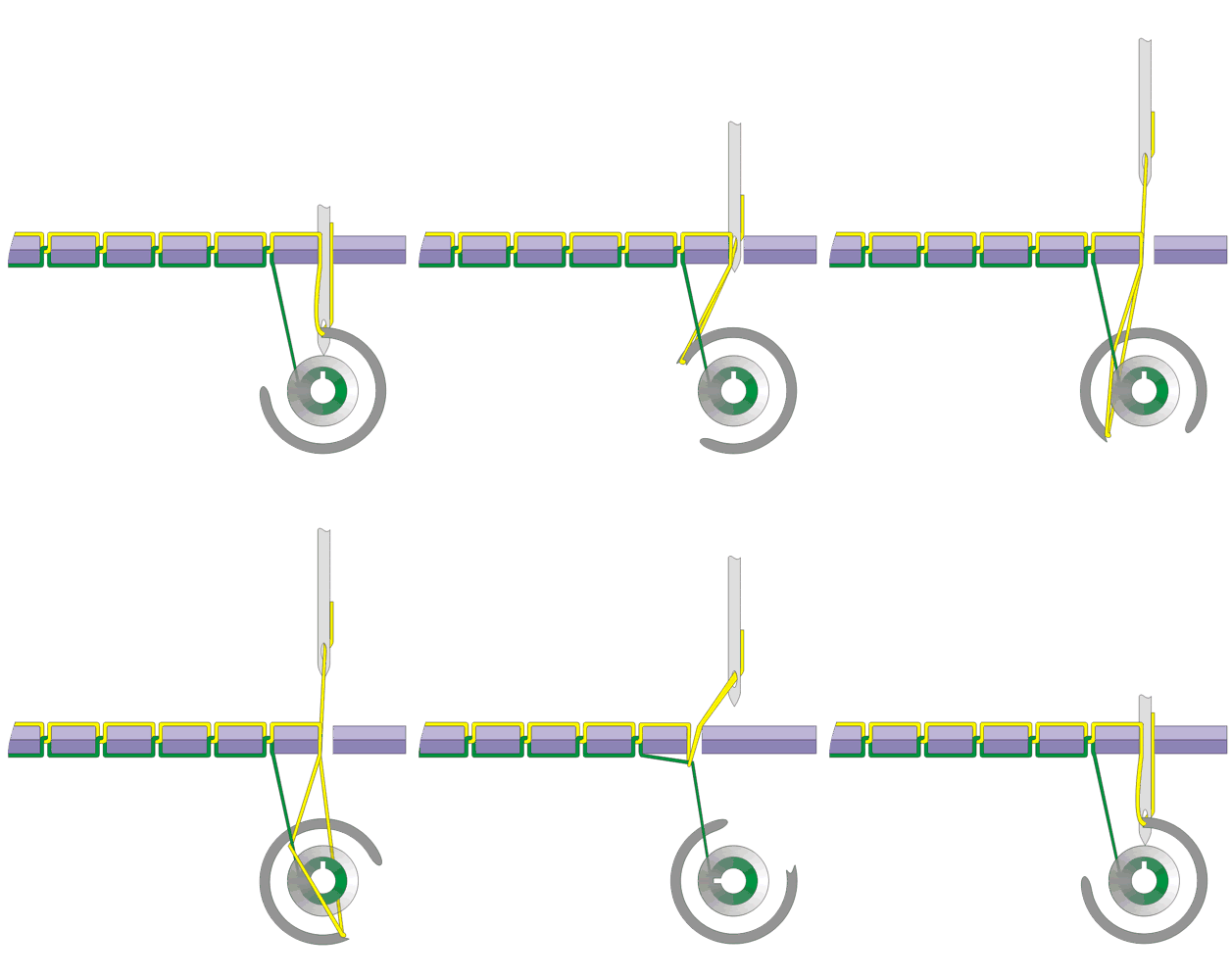
How A Sewing Machine Works

Found this on another blog via a retweeted retweet on Twitter. Very cool animation, considering it's a GIF and not a SWF:


Thanks to Rachelle for retweeting the retweeted tweet.

Wednesday, December 2

Merry Christmas From The Woods Family

Got this from school today. OK, so it's not work (or school) related. Sue me.

Merry Christmas from the Woods Family!

This Is Much Harder Than I Thought

...provided I can keep my wits about me.

In any typical day, I can feel my brain rocketing along at a fever pitch, but once I slow it down a bit and try to remember whatever it is that I was thinking about, those thoughts go right out the window.

OK, some of you don't know my "secret". I'd like to share, but not quite yet. I still have a doctor's appointment scheduled for the middle of this month that will hopefully shed some light on the whole situation. God I hope so. Suffice to say that I have been diagnosed with a condition I've had all my life, always knew there was something wrong, that affects the higher, executive functions that are taken for granted by the majority of the population. I certainly did, until last month when I found out that I wasn't part of that majority. What a mind f*ck that was.

This time, in the school I'm attending, there's much more brain work. Granted, thus far it's all been about loading software on the machines I'm to repair, and I can do that on other machines with my eyes closed.

So while I'm trying to remember all that flies through my psyche in general, and what I'm supposed to be learning, and what my life was like while undiagnosed, and my life since being diagnosed, and what the future holds having that knowledge, and how different the whole experience would be like had I not been diagnosed, well, my head's about to explode.

I just hope there's enough pieces left to pick up.

Tuesday, December 1

Third Night

Sounds like a sixties-vintage song. Maybe I am hallucinating.

Already sick of restaurant food. Would much rather have food made by my significant other, even if it sometimes is only tuna helper. Hell, I'd even like it if I prepared it.

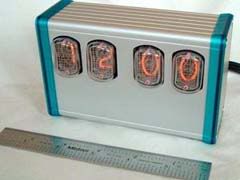
Speaking of vintage, one of my classmates and I were looking at an über-cool website today featuring digital displays of the vacuum-tube variety (valves for those of you across the pond - always got a kick out of the difference). Nixie tubes weren't necessarily all the rage, they simply were all that was available. For you youngsters, this was pre-LED, LCD, plasma, and VFD.

Yes, it was a BFD.

There's something about the hearty glow of a vacuum tube - and whatever the tube happens to be installed in can double as a space heater.

But in my day, all those vacuum tubes were made here in the United States, now they're made elsewhere. More than likely in Russia.

Yup - in BFE.

Wait A Minute. I Smell BS

"Now wait a minute, Bob." [Imaginary quote from an imaginary source.]

"How can you come up with a question like that which you posed last night, and say you have a cognitive deficiency?"

Explaining cognitive deficiencies is like dancing about architecture. You can try, but the outcome is hopelessly erratic and futile. What's more, the more you try to explain it, the more it appears there's nothing wrong.

Years ago, there was this movie called "Brainstorm". In it, a contraption attached to your head would read what you were thinking about and what you were experiencing in your dreams, and record and display them on a monitor. Similarly, these dreams and experiences would be playable to whomever would put the device onto their heads. Think Vulcan mind meld with quad-core processors and a terabyte or three of storage.

Heady stuff.

How useful such a thing would be today, if only to play back for a neurologist for him to see what you were thinking . And how.

Again, as last night, cognitive deficiencies come in many shapes and sizes and are real things that to the outsider might appear as hallucinations. While I don't want myself to appear crazy, I'd rather this just be one more thing that makes me, me.

I'm dancing up a storm.

Monday, November 30

Quantifying States Of Mind

Ooooohhh. That there's some heavy talk, Bob. Is it BS?

I wish it were.

A question to pose of all of you - OK, both of you - is whether it is possible to identify traits that you have, that you know you have, but have never sat down to quantify what those traits are.

A poorly-worded example would be that you know that you hit your head on low-hanging objects but have no idea why.

OK, bad example.

Maybe this example will work better: Suppose you think you have multiple traits of a cognitive nature. Or lack thereof. Say you believe you have some sort of memory loss issue, but cannot come up with any specifics; when asked what kinds of memory problems you have, adding to the distress, you cannot remember what they are. So, being unable to quantify those cognitive deficiencies, you are led to believe that they do not exist.

Welcome to my world.

Tourist Trappings

On this trip, I almost made one of the more serious mistakes in driving south into California, and I'm not speaking of the Sunday after turkey day.

Not even.

No, this is a mistake made by just about anyone in need of a pit stop and/or a quick bite. Since one may also need to get gas and didn't stop in Las Vegas when they should have, or didn't want to pay the exorbitant prices in Baker, you cannot pass by Barstow without stopping for something.

That's why Barstow exists.

I'm not inclined to make this a travelogue of Barstow and all its virtues (let me work on that one for a bit), but what I can say about Barstow is that of all the tourist traps in the world, of all the dumps that can be had as you travel the four corners of the world, stay away from just one place:

Barstow Station

How any reputable establishment - including McDonalds - continues to be associated with that hell hole is beyond me.

Seriously, Barstow Station really needs to be bulldozed.

Sunday, November 29

Lessons Learned

As you may recall, last year Marilee and I tripped to California, mainly due to a seminar she was attending. We did a whirlwind tour of Southern California from San Diego in the south to Santa Barbara to the north. We were away from the normal grind for a week and a half which made the trip that much more pleasing.

All in all, the driving didn't suck too much, thought the drive down between Las Vegas and San Bernardino was the pits. I'd say more than "pits", but this is a family crowd (for the most part).

So wouldn't you think that we, collectively, would have learned that you just do not drive anywhere, of any length, on the Sunday after Thanksgiving?

"Work" has sent me to school again. Same place. Slightly different subject matter.

ON THE SUNDAY AFTER THANKSGIVING. Yes, I could have flown, but that presents its own hassles. So, yes, I drove.

I even left at a decent hour, 7:30am Mountain Time.

I just checked in to the hotel. After driving for 14½ hours, it is now 10pm. Pacific Time. Long Time.

Bed Time.

Friday, November 27

Consistency

...and the lack thereof.

Job opening at The Art Institute listed on Monster this morning:

Irony is what this posting - blog and job alike - is about. That the posting is regarding an IT position is of no matter, but that it is for an artsy-fartsy learning institution is.

I'm guessing that it wasn't an art student that wrote the copy - or in this case edited the copy. But if it was an art student, maybe this is a learning experience to stay away from.

Word to the wise: pick a font already!

Thursday, November 26

Star Wars Thanksgiving

via Twitter

"Away put your congealed cranberry sauce shaped like a can, I mean you no harm."

DIY pr0n

Today on DIYNetwork

Cool Tools Marathon

Tryptophan

A question for the ages:

If tryptophan is the ingredient in Thankgiving turkey that makes you sleepy, why doesn't it make the turkey fall asleep?

Thursday October Christian

So I'm poking around on a website this morning about peculiar, crazy names that parents have named their offspring. Albin stands out prominently, if only because "Albin" is how the name is pronounced; spelled, on the other hand, as:

Brfxxccxxmnpcccclllmmnprxvclmnckssqlbb11116

Yeah, Albin will do nicely.

But what got me thinking in my genetically altered mind was the name "Thursday October Christian".

Born to the infamous Fletcher Christian of "Mutiny on the Bounty" fame, Fletcher wanted a name that didn't remind him of England at all.

Wikipedia's entry on Thursday - the name, not the day - says what's above, as well as what's below:

"Thursday married into his parents' generation."

On what day of the week Thursday got married is unknown.

Anyway.

It got me thinking about generations and when I was born and to which generation.

My Mom was 38 when I was born while my Dad was 46. What generation was I born into? In my childhood, my friends' parents were likely in their 20's. My parents were of an age that could be referred to as my friends' parent's older generation.

If that makes any sense at all - from my genetically altered brain's perspective - I lost a generation. No wonder I got along better with my friends' parents than the kids who were my age.

As a closing example, were my Dad alive today, he'd be celebrating his 100th birthday in three months.

Simply, I was born into the wrong generation.

Wednesday, November 25

Photoshop This Guy In Reflective Shades

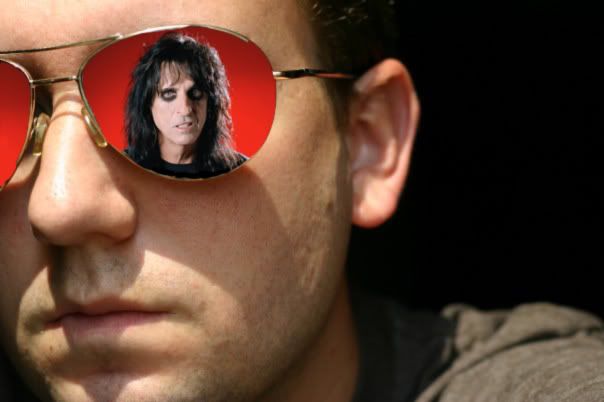
The idea in this Fark Photoshop contest sounded simple enough - "Photoshop This Guy In Reflective Shades". Let's see:

Reflections > Mirrors reflect > Who looked into a mirror > A mirror can be called a "looking glass" > Who looked into a looking glass > ALICE!

But it seemed a little too easy to just paste Alice in Wonderland into the glasses, so I looked for a picture of Alice Cooper.


[Note that any time you have to explain at length what your mind was going through to come up with a Fark Photoshop contest entry, it likely will fail and thou will get no votes. Yup. The only vote was mine.]

Go vote for my entry.

Monday, November 23

The Clapper - PLUS!

Why the hell is it necessary to have a remote for a Clapper?
Doesn't that defeat the purpose of the clapper in the first place?

Why the hell am I concerned?

No More Liquor Licenses!

Thus the ticker at the bottom of the screen on Fox13's morning news broadcast said. Without my emphatic exclamation point, that is.

While that would be earth-shattering news, I suspect it is that there are no more liquor licenses to be had, for all of us imbibers to realize we cannot expect any more taverns to be opening any time soon.

Sigh.

(No, I did not stay around for the actual news piece.)

Sunday, November 22

A New Low

Chia SpongeBOB Squarepants:

Available here. And I double-dog-dare you to get me one for Christmas.

Top Trending Topic Tonight on Twitter

Saturday, November 21

Progress And The Lack Thereof

On Family:

Filtering lines of communication slows down the process. And progress.

Just sayin'.

Friday, November 20

Are Republicans Out Of Touch With Reality?

Not all Republicans, mind you. I have to be careful saying that since I'm a Blue Stater living in a Red State. But still.

At issue is Sarah Palin in her book "Going Rogue" (which admittedly I have not yet read) saying she played a role in "achieving victory" for the victims of the Exxon-Valdez disaster even when she is on record at the time saying she was "very, very disappointed" and heart-broken with the decision that she called "not right".


Reminds me of the Mission Accomplished banner behind George Bush.

(From Andrew Sullivan's blog at The Atlantic.)

Pivot!

In what has become an all-too-common, bordering on an obnoxiously overused term in our house, is the word "pivot".

Any time someone in the house needs to turn a corner, or flip to the other side of the bed, or even when it's not needed in context, one of us will utter the word.

PIVOT!

And not just said in a Webster's dictionary sense. It's in the voice of Ross Geller:


Shut up! Shut up! SHUT UP!

Thursday, November 19

Tsk Tsk Tsk

That was the sound Marilee just made.

"I'M ALWAYS RIGHT" was what she said just prior to tsking.

What brought that on was that we'd been discussing a medical condition I've been tested positive for, and no, I don't care to share that just yet. Having a relation to AD(H)D, she had said a night or two ago that in some people caffeine can have a calming effect. I know for a fact that's true for me, since a big cup of coffee is all it takes to set me up for a good night's sleep.

Really.

The why's and wherefores have to do with chemical imbalances in the brain; something more for me to reseach.

I'd just searched for the reference when Marilee told me the capitalized comment above.

It may take some time, though, for her to try the coffee trick. At least it works for me.

The Road To Hell Is Paved With Good Intentions

Marilee just uttered the phrase "Good Intentions", without the prefix of demonic possession. Admittedly, I had to look up the entire phrase.

This dialog was prompted by another discussion I'd rather not comment on in front of God and everybody for fear of reprisal.

Suffice to say that Marilee cemented my position as the writer in the family by saying the following, verbatim:

"Good Intentions. AIN'T!"

That's "NOT", dear.

Wednesday, November 18

The Missing Hip

OK, it's a foregone conclusion that magazines have forever airbrushed out blemishes, zits, you name it, from prominent models and celebrities. But to remove a whole chunk of a thigh?

Shown at the "OMG!" blog is a Photoshop session gone wrong. A portion of the image shown there is shown below:

Article here.

Morning Activities

This morning, Marilee is up waaay before I. She does, after all, have a sleeping problem, and as is the case most mornings, she's up far before the crack of dawn. Today, three-thirty to be exact.

But she's got an excuse today: She's getting her picture taken and has to look her best. After all, she's going to have this picture following her around for several years.

In a procrastination exercise gone wrong, she has waited until the last minute to get her Driver's License. That, and she never alerted the license people her name changed. Three years ago. Her birthday, by the way, is this Saturday. Be sure to write on her wall at Facebook.

Not that I was proactive the last time mine was due. I got mine on my birthday in 2006 and won't have to get another bad picture until 2012.

Now that I think of it, I wonder how many times a day the folks at the Driver's License division say Happy Birthday.

No need to wonder - I'll ask.

Tuesday, November 17

Twitter Ends Political Partisanship

WTF?

From an article via AP and Google News:

"Social-networking site Twitter plans to end a service that links prominent message posters with new users, a service that was criticized in California because of perceived unfairness toward GOP gubernatorial candidates."

Is anything in California NOT criticized?

Monday, November 16

My Whelm Factor Is Off The Charts

Last week I received a report from my doctor I had been suspecting but wasn't ready to accept.

I won't go into detail now - and don't ask - but rest assured it's not life-threatening.

After the initial shock wears off, I'll share.

Which may take decades...

Saturday, November 14

Magnetic Personalities

For whatever reason, Marilee has this peculiar fascination with magnets. Most often, it's magnetic fasteners of the purse and/or eyeglass case variety. But anything magnetic will get her attention.

I saw these the other day in a catalog - methinks it would be the perfect gift.


Hey, at least my "perfect gift" for my wife isn't a leaf blower.

Thursday, November 12

Shopping, Shopping, Shopping

Dangerous enough that Marilee and Jenn were out last evening shopping. Looking for bargains. Mother and daughter. Scary sh!t.

Anyway.

Marilee was looking for some greeting card supplies of the Martha Stewart variety and couldn't find anything she liked - they even went to Big Lots. Jenn suggested she look on eBay.

Even scarier sh!t.

So this morning, after having found something to her liking, I bid on it for her.

We talked about the subject a bit, and then it dawned on me that she should look on etsy.

"You should never have told me about that."

Marilee has a new hobby.

et$y.

Double Dipping

It's about damn time.

In this morning's DesNews is an article regarding a practice in state government that really, really needs to end.

It's the practice of state agencies re-hiring employees who have retired from that same agency. Sure, the logic is there: hire someone who already knows the job and the requirements. Doesn't need to be trained. Known to be reliable. But there's a catch.

That same person who has retired is collecting a state-supplied pension in addition to their salary.

The article states that over the next ten years the practice will cost the state 900 million dollars. That's $900,000,000. Be easy on us and call it a billion.

Get on the phone. Call your legislator. End this now.

Wednesday, November 11

Who ARE You?

"So is this the new Marilee?", I say to my lovely wife just now.

At six-thirty in the morning.

On a weekday.

She's got something scheduled for today and apparently wanted to get going as soon as possible so as to not dawdle before she really needs to be off.

Oh, the answer?

"No, just another one."

Oh. My. God.

Tuesday, November 10

More Christmas Acceleration

Seen today at the corner of 90th South and State Street, a Christmas Tree lot being assembled.

You wanna bet how crispy those trees will be by Christmas?

A better bet is to get a fresh tree from DeLong Farms. One year I got one and it was still flexible by January 31st - my birthday.

It's really an amazing treat to receive a tree shipped in a wax-lined box. From Canada.

Simple Swedish

His English is still better than your Swedish:


Fair warning - you may want to turn your volume down - certain four letter words are pronounced, with typically comedic results.

Monday, November 9

Fascinating Poll

In the DesNews this morning, a poll conducted by Dan Jones and Associates is asking what President Obama should do in Afghanistan.

The poll results:

  • Pull all troops out of country: 17%
  • Keep the current number of troops: 14%
  • Send less than 40,000 troops: 14%
  • Send 40,000 or more troops: 35%
  • Other: 6%
  • Don't know: 14%
What's actually said in the first gripping paragraph of the article belies description:

"Utahns are split over what to do about Afghanistan: Send more troops, pull out, drop back 10 yards and punt?"

Exactly which of those poll questions speaks of football?

Sunday, November 8

Who Framed Harvey

Another of my all-too-infrequent Fark Photoshop entries.

This one has a rather easy premise - Photoshop two movie posters into one:


Hope you like it.

Friday, November 6

Who's Smarter Than Who(m)?

The Trivial Pursuit Experiment wants to know:

Wednesday, November 4

Am I The Only One Who Hasn't Seen This?

At left is the logo for Cisco Systems.

Maybe it was because I always saw that which is above "Cisco" as a waveform. Something you would see on an oscilloscope.

But look closer. And think of California landmarks.

Yes, it looks like the Golden Gate Bridge.

While Cisco is now located in San Jose, it is in the neighborhood of another California city.

Yes, Cisco is located nearby SAN FRAN.

CISCO.
Related Posts with Thumbnails
Google Analytics Alternative